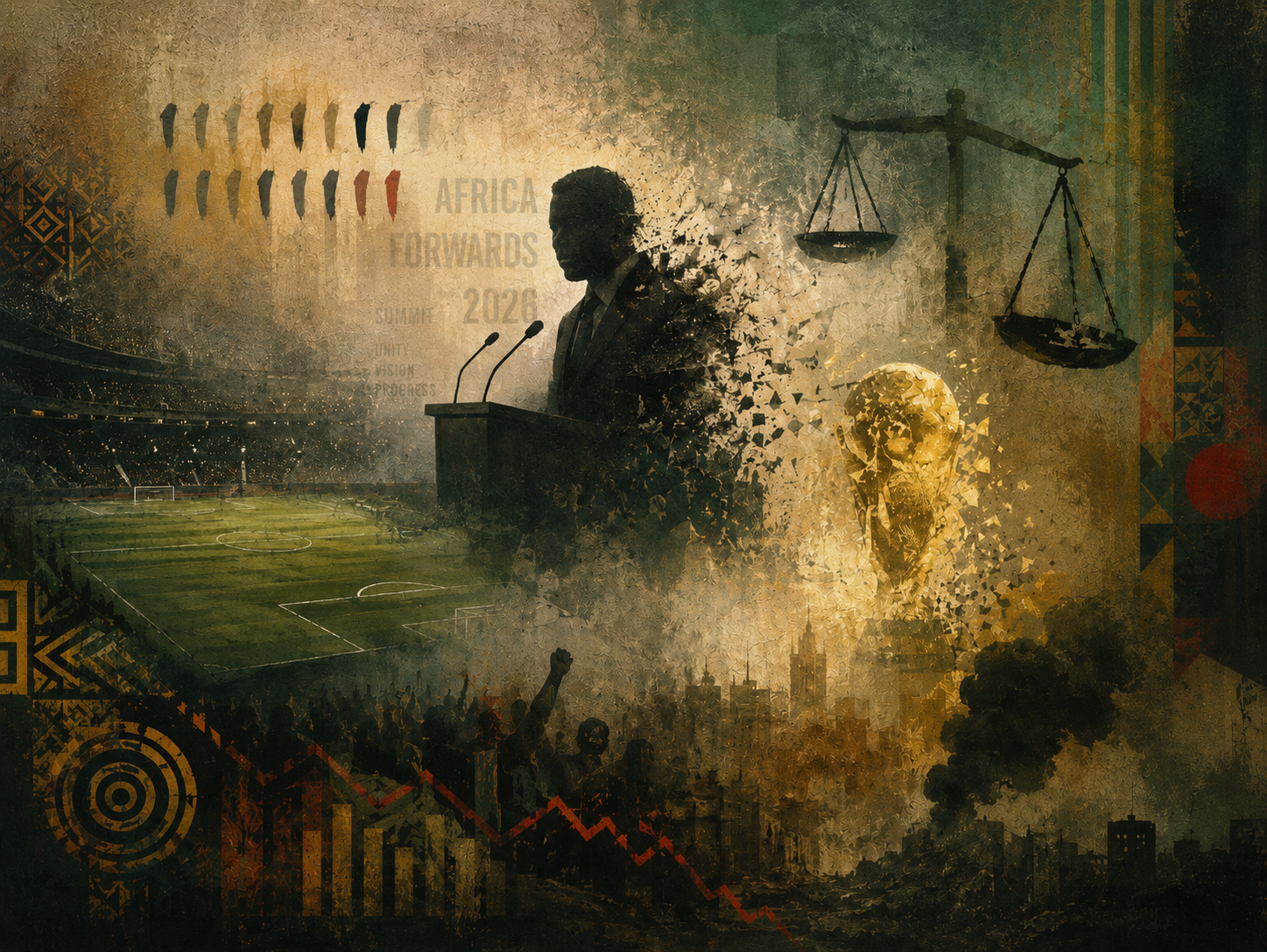
That is what happened during the final of Africa’s latest continental tournament, when a West African team left the pitch for 17 minutes in protest against a refereeing decision. They would later return, finish the match and celebrate what, at first, looked like a historic triumph. The trophy was lifted. Flags were waved. A country, already searching for symbols of unity, was offered a moment of collective pride.
But modern football does not end at the final whistle.
Soon, the story moved from the stadium to the corridors of African football governance, then to the legal architecture of international sport. A continental ruling later shifted the meaning of that victory, declaring the North African side the rightful winner, while an appeal before the Court of Arbitration for Sport left the final verdict suspended somewhere between law, politics and wounded pride.
It is in this context that recent remarks made at the Africa Forwards 2026 summit deserve closer scrutiny.
At an event meant to discuss the continent’s economic future — investment, industrialisation, reform, innovation and the long struggle for African sovereignty in a shifting global order — a senior West African leader chose to begin by declaring: “We are African champions.”
On the surface, it was a simple line. A crowd-pleasing reference to sporting success. A familiar appeal to national pride.
But politics is rarely only about what is said. It is also about when it is said, where it is said, and what reality it attempts to cover.
At a summit designed to project seriousness, confidence and economic ambition, the reference to football felt strikingly out of place. Not because sport has no political meaning — in Africa, perhaps more than anywhere else, football can be a language of dignity, resistance and recognition — but because the victory being invoked remains contested, institutionally fragile and symbolically loaded.
The 17-minute walkout matters because it revealed something deeper than anger at a referee. It exposed a political culture in which emotion can challenge procedure, where symbolic defiance can become more powerful than institutional discipline, and where a nation’s need for pride may collide with the rules that govern collective life.
A country can leave the pitch and still claim victory. But can it build credibility by refusing the terms of the game?
That question extends far beyond football.
Across parts of the continent, governments increasingly rely on symbolic victories to compensate for structural uncertainty. Sporting triumphs, diplomatic slogans and grand continental speeches are used to manufacture unity at moments when societies are under pressure. When unemployment rises, when public finances tighten, when political trust erodes and social frustration grows, the language of pride becomes a valuable political resource.
Football, in that sense, becomes more than entertainment. It becomes a national sedative.
The danger is not that leaders celebrate sporting success. Nations need symbols. People need moments of joy. In countries facing economic hardship and political fatigue, collective celebration can provide rare emotional relief.
The danger lies in confusing symbolism with strategy.
Africa Forwards 2026 was supposed to be about the future: how the continent can attract capital without surrendering sovereignty; how it can industrialise without deepening inequality; how it can turn demographic growth into opportunity rather than instability; how it can build institutions capable of surviving political turbulence.
Against such a backdrop, beginning with a contested football triumph carried an unintended message. It suggested a preference for emotional legitimacy over institutional clarity, for applause over analysis, for memory over programme.
The image is almost too powerful: a leader at a podium speaking of victory, while behind the word “champion” lingers the shadow of an abandoned pitch, a delayed match, a disputed trophy and a pending legal verdict.
This is not merely about one final. Nor is it about one country.
It speaks to a wider African dilemma: the struggle to convert symbolic power into institutional power. The continent has no shortage of talent, pride, resilience or cultural influence. What remains more difficult is the patient work of building systems — judicial, economic, educational and political — that command trust even when outcomes are unfavourable.
True power is not only the ability to win. It is the ability to accept rules, endure scrutiny and remain credible when victory is questioned.
That is why the 17 minutes should not be forgotten. They are not just an episode in African football history. They are a political metaphor.
They tell the story of a nation — and perhaps of a generation of leadership — caught between performance and governance, between the theatre of pride and the discipline of institutions, between the desire to appear strong and the harder task of becoming stable.
The summit was called Africa Forwards. Yet the most revealing image came from a team that, for 17 minutes, walked away.
And sometimes, in the silence of an empty pitch, one understands more about the condition of a country than in all the speeches delivered under the bright lights of international forums.

💬 Comments (0)
No comments yet. Be the first!
✏️ Leave a comment