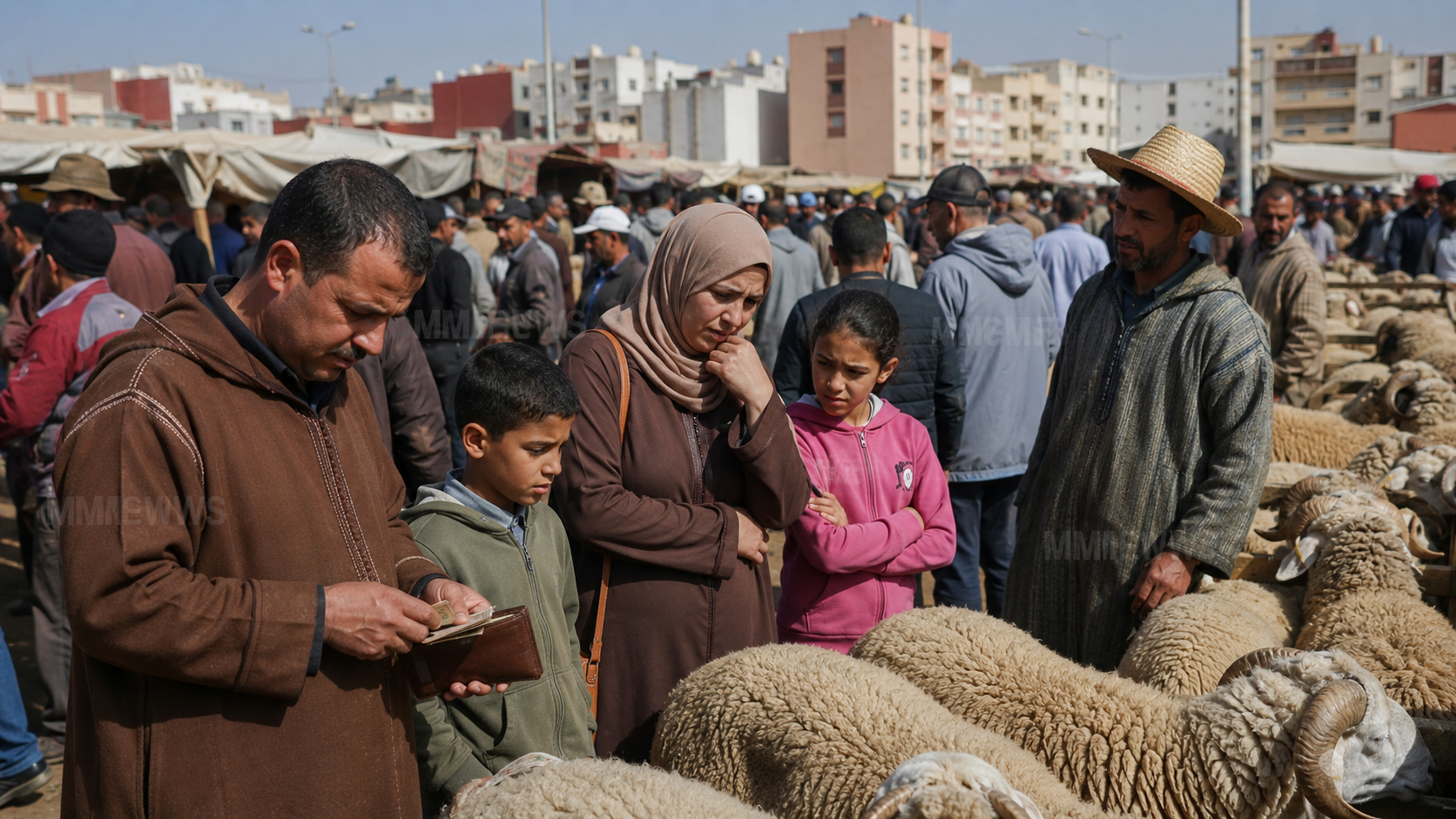
Official figures looked reassuring. The market felt different.
Before Eid, official figures indicated that Morocco had enough livestock to meet demand. The announced national supply was estimated at 8 to 9 million heads of sheep and goats, while demand was expected to range between 6 and 7 million heads. Authorities also referred to a national herd of around 40 million heads, the registration of approximately 160,000 breeding and fattening units, thousands of sanitary control operations, and the creation of temporary markets to support distribution.
On paper, the equation looked simple: supply was higher than demand.
But for many citizens, the reality in the markets felt very different. In the final days before Eid, several buyers reported high prices, limited affordable options, strong pressure from sellers, and confusion over whether prices would fall or rise at the last minute.
This is where the first major question begins: if supply was comfortably above demand, why did so many Moroccan families not feel that abundance in the final price?
Because for the average citizen, abundance is not measured only by national livestock numbers. It is measured by what is available in the local market, at the right time, at a price the household can actually pay.
Was the real issue supply, or affordability?
This year’s problem may not have been a total lack of animals. The deeper issue was affordability.
A sheep can exist in the national supply chain and still be out of reach for ordinary families. It can be available in rural production areas but become too expensive once transport, intermediaries, feed costs, margins, and last-minute demand are added.
This is the difference between statistical availability and social accessibility.
The government may announce that the country has enough animals. But the citizen asks a different set of questions:
Where are they?
At what price?
In which markets?
Who controls the final margin?
And how many of those animals are actually within the budget of an average Moroccan household?
A family does not buy an official statement. A family buys a sheep. And when that sheep costs more than what the household can afford, the official language of “sufficient supply” loses part of its meaning.
The average Moroccan was the weakest link
The biggest loser in this year’s Eid market was the average Moroccan citizen.
Not necessarily the poorest, who may already be forced to give up the sacrifice, and not the wealthy, who can pay regardless of price. The most affected were often those in the middle: employees, workers, small earners, modest households, and families trying to balance rent, food, school expenses, medical costs, transport, and family obligations.
For them, the sheep became a painful financial equation.
Should they buy?
Should they borrow?
Should they wait for a price drop?
Should they split the cost with relatives?
Should they give up the sacrifice this year?
These are not only economic questions. They are questions of social dignity.
In Morocco, Eid Al-Adha is deeply rooted in family life. It is tied to childhood memories, neighborhood traditions, religious meaning, and the feeling of belonging. When the sacrifice becomes financially stressful, the celebration loses part of its spirit.
The issue is therefore not only about sheep prices. It is about the pressure on household purchasing power.
Moroccans abroad: coming home, then facing an unexpected shock
Moroccans living abroad were also part of this year’s story. Many returned to Morocco to celebrate Eid with their families, hoping to reconnect their children with the atmosphere of the “bled” and revive a tradition that carries strong emotional value.
But for some, the return became more expensive than expected.
Air or ferry tickets, local transport, gifts for relatives, family expenses, accommodation, and then the price of the sheep — the total bill quickly became heavy.
There is also another issue: some Moroccans abroad feel that local markets sometimes treat them as if they can automatically afford higher prices simply because they live in Europe, Canada, the Gulf, or elsewhere. That assumption is unfair.
Not all Moroccan expatriates are wealthy. Many face high rents, taxes, loans, inflation, school fees, and daily financial pressure in their countries of residence.
For some MRE families, Eid in Morocco was supposed to be a joyful return. Instead, the final days before the celebration were spent searching for a reasonably priced sheep, negotiating under pressure, and feeling that the holiday atmosphere had been damaged.
That experience matters. The relationship between Morocco and its diaspora is not built only through airports, ports, speeches, and official welcomes. It is also built through everyday experiences: prices, treatment, trust, and the feeling that returning home remains a source of comfort rather than stress.
Social media: a useful alarm bell or a panic machine?
This year, social media played a central role. It became a parallel marketplace of information, anger, rumors, videos, calls for boycott, and emotional reactions.
On one side, social media helped expose real frustration. Citizens shared videos from markets, compared prices, criticized speculation, and gave visibility to families struggling with the cost of Eid. This was useful because it showed a side of reality that official communication does not always capture.
But on the other side, social media also amplified confusion.
Some extreme prices were presented as if they represented the entire national market. Some videos circulated without context. Some boycott calls created the expectation that prices would collapse at the last minute. Many citizens waited, hoping for a drop. When the drop did not come, they found themselves facing even stronger pressure in the final days.
The result was a market driven not only by supply and demand, but also by fear, expectation, rumor, and social pressure.
The sheep market became an emotional market.
Boycott campaigns: real anger, complicated reality
The boycott calls reflected genuine anger. They should not be dismissed as a passing online trend. When the price of a religious sacrifice becomes too high for a large part of society, public frustration is legitimate.
But Moroccan society is complex.
Eid Al-Adha is not a normal consumer product that families can simply remove from their shopping list. It carries religious meaning, family expectations, children’s memories, and social pressure. For many households, giving up the sacrifice is not an easy decision.
This explains the contradiction seen in the final days: many people supported the boycott emotionally, but still felt compelled to buy. Others waited for a price drop, then bought at a higher price than expected. Some did boycott, but experienced it not as a victory, but as a painful necessity.
The boycott debate revealed something deeper: many Moroccan families feel that their purchasing power no longer matches the cost of maintaining basic social and religious traditions.
Questions the government should answer
After Eid, citizens deserve clear answers. Asking questions does not mean attacking the state. It means demanding transparency, evaluation, and accountability.
First question: where exactly were the 8 to 9 million heads announced before Eid?
Were they evenly distributed across regions? Did they reach major urban markets in sufficient quantity?
Second question: how many of those animals were actually suitable for Eid sacrifice?
A global supply figure does not necessarily mean that all animals met the conditions, size, quality, and price range expected by families.
Third question: what role did intermediaries play in the final price?
How many times did the animal change hands before reaching the consumer? What margins were added at each stage?
Fourth question: were temporary markets enough?
Did they genuinely reduce pressure on prices? Were they well located? Did they create real competition, or did their effect remain limited?
Fifth question: if supply exceeded demand, why did prices remain so high?
In basic market logic, comfortable supply should ease prices. If that did not happen, the public deserves to know why.
Sixth question: what will be done differently next year?
Citizens do not only need reassuring figures before Eid. They need a serious post-Eid assessment and practical measures for the future.
Asking for answers is not hostility
It is important to be fair. Livestock farmers have also faced difficult years. Drought, feed prices, transport costs, fattening expenses, veterinary care, and fuel prices have all affected the sector.
Small breeders are not automatically the winners of high prices. Many of them are under pressure too.
But the final burden cannot always fall on the consumer. If production costs rise, if intermediaries multiply, if transport becomes expensive, if pricing lacks transparency, and if last-minute speculation appears, the Moroccan household ends up paying the full price of the system.
That is why this issue requires a full review — from farm to market, from policy to consumer, from official figures to lived reality.
What needs to change?
The first lesson is that official communication must become more precise. It is not enough to say that supply is available. Citizens need to know supply by region, by category, by quality, by expected price range, and by market access.
The second lesson is the need for price transparency. Families should not discover market reality only in the final days before Eid.
The third lesson is stronger monitoring of intermediaries and speculative behavior, especially during the final week, when buyers are under emotional pressure.
The fourth lesson is the need to think seriously about households with limited and middle incomes. Eid should not become a financial burden paid through debt or by sacrificing other essential expenses.
The fifth lesson is that authorities must deal more intelligently with social media. Ignoring online anger is not enough. Public institutions need fast, clear, simple communication to correct rumors, explain market conditions, and reduce panic.
Eid is over, but the questions remain
This year’s Eid Al-Adha revealed a visible gap between official reassurance and public experience.
Maybe the national supply was sufficient in numbers. But for many citizens, the real question was much simpler: could they buy a sheep without damaging the family budget?
For many, the answer was not reassuring.
This episode reflects a wider reality: Moroccan purchasing power is under constant pressure. And when that pressure reaches Eid Al-Adha, the issue becomes more than a market problem. It becomes a matter of public trust, social dignity, and the ability of policies to protect ordinary families.
The point now is not to blame one actor alone. Farmers, intermediaries, consumers, social media, drought, costs, and public policy all played a role. But the government, because it holds responsibility, must provide a clear assessment of what happened.
Eid Al-Adha is not just about a sheep.
It is a test of trust.
A test of purchasing power.
And a test of whether the market serves citizens — or drains them.

💬 التعليقات (0)
لا توجد تعليقات. كن أول من يعلق!
✏️ اكتب تعليقك