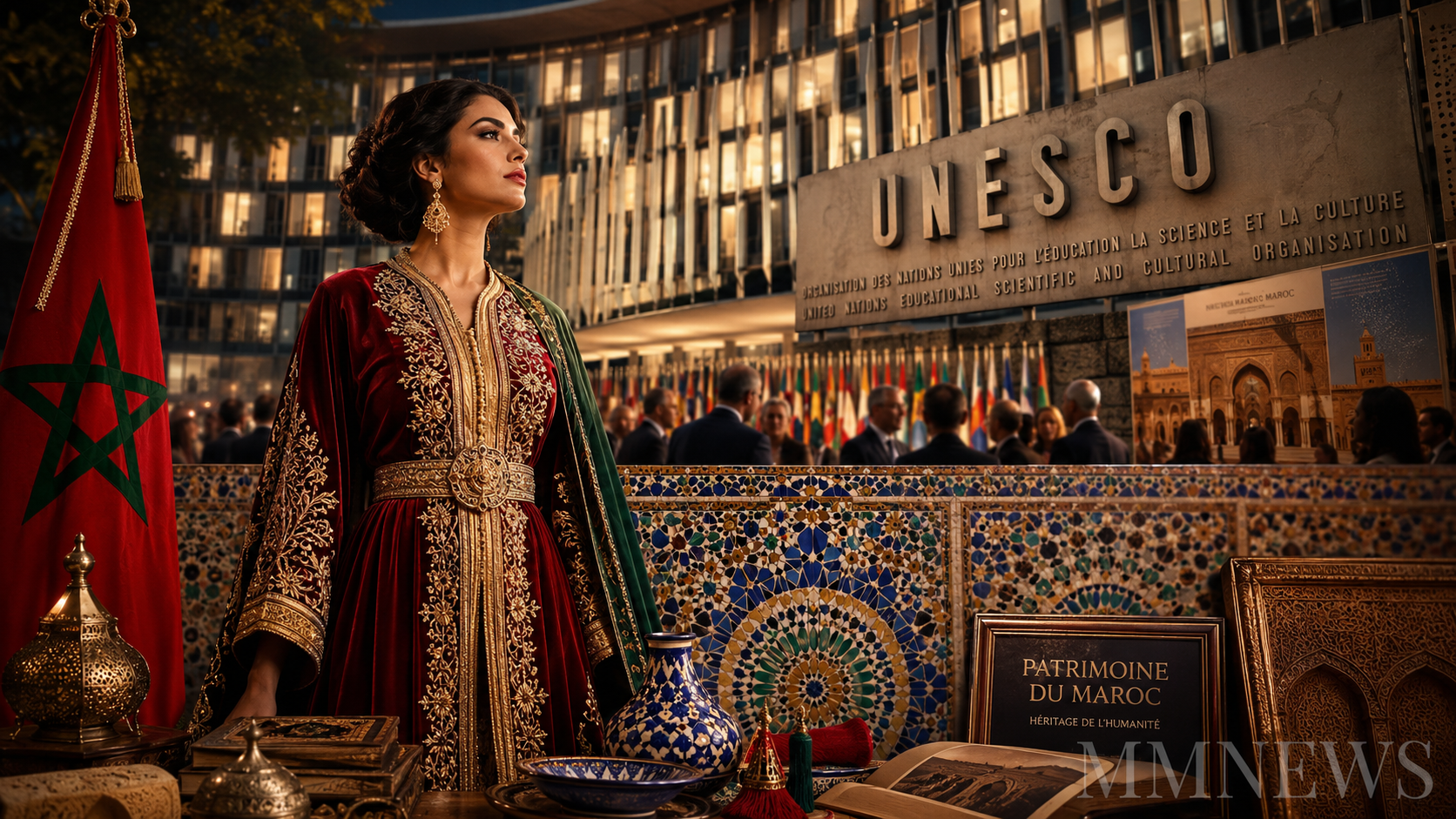
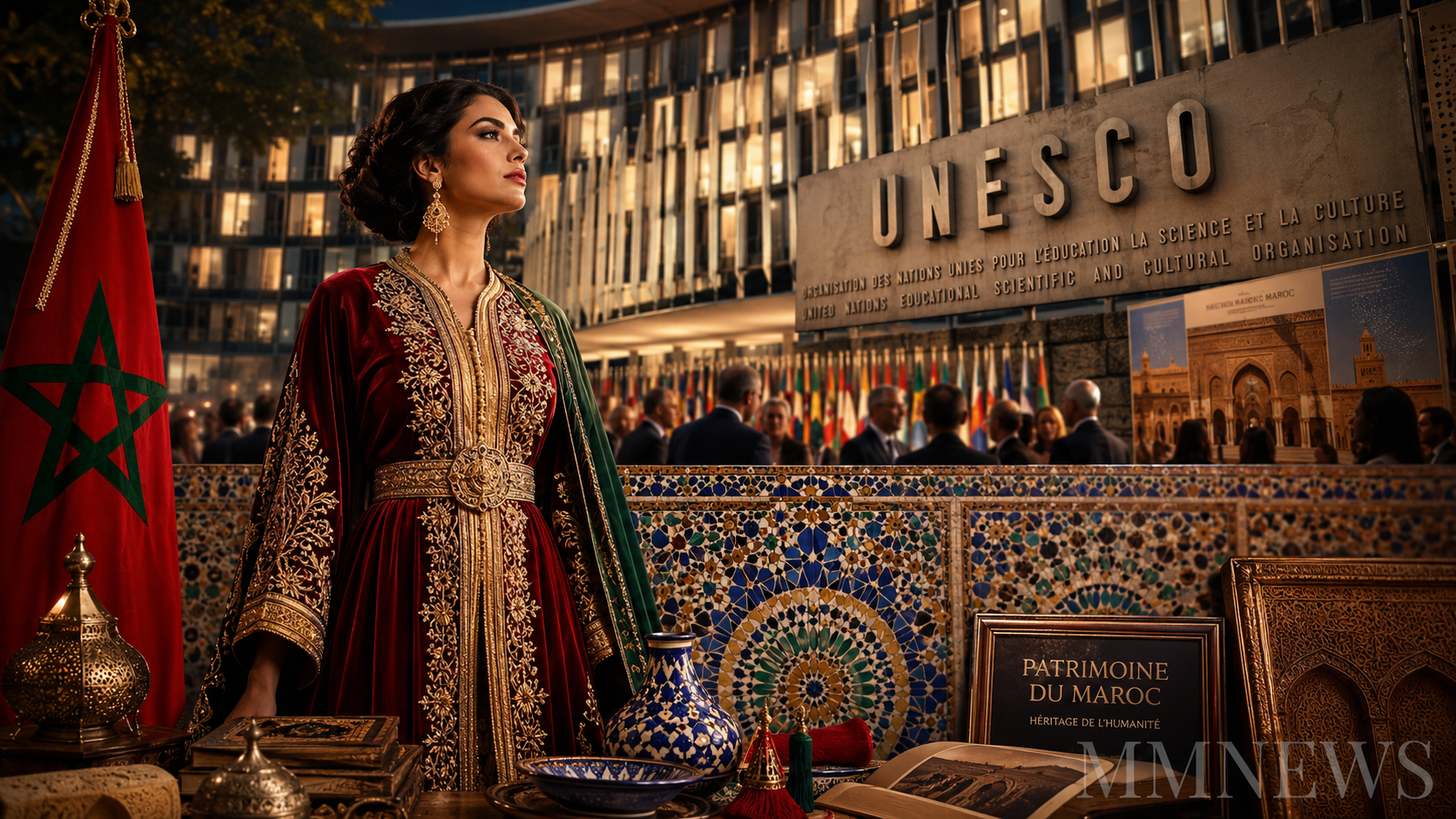
brought together African countries, institutions, experts and cultural actors around themes related to development, youth, culture, heritage, environment and cooperation. Yet the tensions surrounding certain cultural symbols showed once again how heritage, when removed from its civilizational context, can become the object of unhealthy political rivalry.
For Morocco, the issue goes far beyond a single incident or a media controversy. It is part of a broader effort to defend a centuries-old cultural legacy through documentation, diplomacy, international law and institutional recognition.
UNESCO Is a Forum for Dialogue, Not Confrontation
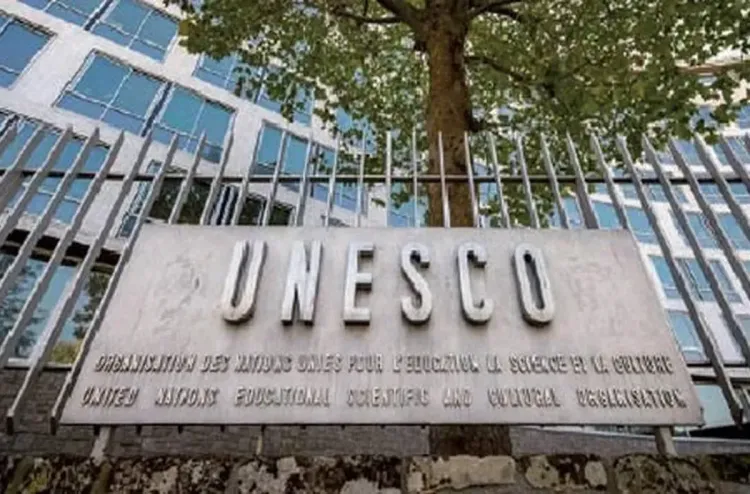
UNESCO was founded on a central belief: peace must be built through education, science and culture. It is not merely a venue for cultural displays. It is an international institution carrying a moral and humanistic mission.
Within such a space, traditional clothing, craftsmanship, architectural arts or cultural symbols should never be used as tools of provocation. They should serve as bridges between peoples, not as instruments of tension.
Every country has the right to present and defend its heritage. But that right must be exercised with respect, diplomatic restraint and adherence to the procedures of international organizations. This is precisely where Morocco’s position gains strength: it defends its heritage not through noise, but through history, evidence, legal files and institutional mechanisms.
Morocco Is Not Defending Claims, but a Historical Continuity
The strength of Morocco’s case lies in the fact that the Kingdom is not starting from empty ground. Moroccan heritage is not a recent narrative, a political reaction or a temporary cultural campaign. It is a long civilizational accumulation shaped by ancient cities, family traditions, artisan workshops, religious spaces, palaces, medinas and generations of craftsmen and women.
From Fez to Marrakech, from Tetouan to Rabat, from Essaouira to Meknes, Morocco carries a diverse cultural identity shaped by Amazigh, Arab, Andalusian, African and Mediterranean influences. This richness cannot be reduced to a viral video or a diplomatic dispute.
The Moroccan Caftan: International Recognition of a Living Memory
The Moroccan caftan is one of the strongest symbols of this cultural depth. It is not simply a traditional garment. It is a social and aesthetic memory. It is linked to weddings, religious celebrations, family ceremonies, embroidery, fabrics, colors, cuts and regional styles.
The inscription of “Moroccan Caftan: Art, Traditions and Skills” on UNESCO’s Representative List of the Intangible Cultural Heritage of Humanity confirmed this depth. This recognition did not come from emotion or publicity. It came through an institutional process based on documentation, historical depth, living practices and communities that continue to transmit this heritage.
This point matters. Recognizing the Moroccan caftan does not deny that other countries have their own traditional garments. It means that Morocco presented a specific element of its living heritage, with its own context, history, skills and communities. That is the very spirit of the UNESCO Convention for the Safeguarding of the Intangible Cultural Heritage.
The Caftan Is Not a Political Slogan
The Moroccan caftan is deeper than any controversy. It existed in Moroccan homes before it appeared in international forums. It is worn during celebrations, preserved by families, developed by artisans and constantly renewed by Moroccan creativity.
Turning it into a political dispute does it a disservice. The caftan does not need shouting to prove its authenticity. One only needs to look at Moroccan artisan workshops, historic cities, old family photographs, museums and collective memory to understand that it is part of Morocco’s living identity.
Moroccan Zellige: A Deep Architectural Language
Alongside the caftan, Moroccan zellige stands as one of the most visible expressions of Moroccan visual identity. It adorns mosques, madrasas, palaces, riads, fountains, mausoleums and traditional homes. It is not simply decoration. It is geometry, color, patience, precision and craft.
Here, accuracy is essential. Unlike the caftan, Moroccan zellige is not yet recognized as a standalone Moroccan element on UNESCO’s Representative List of intangible heritage. However, Morocco has been working to document and strengthen the protection of this art internationally.
Its legitimacy does not depend only on future institutional recognition. It is visible in Moroccan architecture itself, in Fez, Tetouan, Marrakech, Rabat, Meknes and other cities where zellige is part of the urban and artistic identity.
Defending Moroccan zellige should therefore rely on archives, artisans, historical monuments, schools of craftsmanship and scientific research. These elements give Morocco a strong and credible foundation.
What the Incident Reveals: Moroccan Heritage Has Become Soft Power
The growing sensitivity around Moroccan heritage reveals an important truth: Morocco is increasingly present in cultural diplomacy. When a country succeeds in documenting and promoting its heritage internationally, it strengthens its symbolic influence.
Morocco has understood that heritage is not only memory. It is also soft power. It supports tourism, strengthens craftsmanship, enhances the Kingdom’s image and connects younger generations to their identity.
Any attempt to disturb this trajectory should not push Morocco into emotional reaction. On the contrary, it should encourage more organization, more documentation and stronger diplomatic advocacy.
Diplomacy Requires Restraint
In international institutions, delegations do not merely represent themselves. They represent states, diplomatic traditions and national images. That requires discipline.
Even in cases of disagreement, there are rules. Cultural or historical disputes must not be addressed through friction or provocation. They should be handled through official channels: formal communications, rights of reply, expert files, specialized committees and structured dialogue.
This is where the Moroccan approach matters. When Morocco defends its heritage at UNESCO, it does so as a state aware that the strength of a file is more powerful than the heat of the moment.
Defending Morocco Means Elevating the Debate
Morocco’s strongest response is not to trade accusations. It is to raise the level of the discussion.
Morocco can say to the world: here are our cities, our workshops, our artisans, our families, our documents, our living practices and our international recognitions.
This language is stronger than controversy. It moves the debate from emotion to evidence, from noise to knowledge, from tension to law.
The media also has a responsibility here. Defending Moroccan heritage should not only be emotional. It must be professional, attractive, accurate and capable of speaking to Moroccan and international readers alike.
Moroccan Heritage Is Not a Reaction to Anyone
It is important to remember that Moroccan heritage was not born as a reaction to any other country. The caftan did not appear because someone contested it. Zellige did not become part of Moroccan architecture because of a modern dispute. Moroccan cuisine, music, craftsmanship and lifestyle did not emerge from social media debates.
This heritage exists because it is part of Morocco’s history. That is where its strength lies. Authentic culture does not need an opponent to prove its existence. It draws legitimacy from continuity, daily use and transmission across generations.
UNESCO Must Protect Its Own Spirit
The incident also raises a responsibility for UNESCO itself. If the organization wants to remain a space for culture and peace, it must ensure that its events do not become arenas of tension between states.
The philosophy of intangible cultural heritage is based on safeguarding, respect and cooperation, not aggressive competition. Protecting heritage therefore means not only listing it, but also protecting the spaces in which it is presented from provocation and disorder.
Why This Matters to Moroccans
Heritage is not cold material. It is personal and collective memory. For many Moroccans, the caftan is not simply a garment. It is a mother, a grandmother, a bride, a family celebration. Zellige is not just decoration. It is an old house, a mosque, a madrasa, a fountain, a historic city.
That is why Moroccans react strongly to these issues. They do not see them as technical cultural debates. They see them as matters touching their memory.
But the more sensitive the subject, the more dignified the response must be. A cherished heritage deserves a defense that matches its value.
Morocco Defends Its Heritage with Confidence and Elegance
The incident on the sidelines of UNESCO’s Africa Week reminds us of a clear reality: Moroccan heritage has become an object of international attention and a source of soft power for the Kingdom. That visibility may sometimes generate sensitivities or attempts to disturb the narrative.
But Morocco has something stronger than noise: history, artisans, memory, institutions, documented files and international recognition.
The inscription of the Moroccan caftan at UNESCO is a clear example of how calm and organized cultural diplomacy can deliver results. Moroccan zellige, with its architectural and artisanal depth, also deserves to be defended with the same seriousness and vision.
In the end, defending Moroccan heritage does not mean being drawn into tension. It means standing firm, being precise, using diplomacy and trusting the strength of history. Morocco does not need to raise its voice to defend its culture. It only needs to raise the quality of its argument.
💬 التعليقات (0)
لا توجد تعليقات. كن أول من يعلق!
✏️ اكتب تعليقك